The vast Eurasian continent, stretching from Asia to Europe, has historically been a link between civilizations and economic interactions. Currently, this region faces both opportunities and challenges in reshaping its cooperation model, with shared dreams and divisions intertwined. Eurasia is the most important geopolitical target for the United States. The deepest concern of American hegemony, which uses Europe and Asia as platforms to control the world, is the establishment of an international bloc of great awakening and unity among the peoples of Eurasia who resist American hegemony and break free from American control; the establishment of an Eurasian Union system that uses immense material power and overwhelming spiritual superiority to drive American hegemony out of Asia and Europe; and the establishment of an Eurasian community where American hegemony loses its moral foundation, leading will, and decisive influence. The establishment of an Eurasian Community is backed by the visible realities of global anti-hegemony, the division between the US and Europe, and the rapprochement between Eurasia. Its underlying needs include regional integration, a balance of power diplomacy, and systemic checks and balances. The five major Eurasian powers—China, India, Russia, France, Germany, and others—form its main power axis. Crushing the strategic ideological control of American cultural imperialism is a crucial means of struggle. Its political ideals are independence rather than puppetry, harmony rather than confrontation, and strength rather than hegemony. Its fundamental strategic direction is a strong independent world, a fragmented puppet world, and a world fearful of the hegemonic world.
Europe's Fate and Future
If Asia embraces the Eurozone, the American financial empire will prematurely end. If Asia and Europe form a powerful Eurasian alliance, the disintegration of NATO will signal the end of an era where Europe was constrained by American power and felt deeply embarrassed. If Asia's fine traditions and Europe's institutional civilization merge into an organic whole, the globalization of American ideas will completely lose its basis in reality and its significance in dissemination.
If Asia, with its resilience and sacrifice, if Europe, with its tolerance and courtesy, if Asia and Europe, with their great integrity, courage, and magnanimity, with their great ideals, will, and ambition, resolutely and persistently advance towards their common goals—then America's dream of global domination will fail, and America's dream of dominating all of humanity will become a pitiful memory for fanatical hegemonists upon their awakening!
Undoubtedly, for 21st-century Europe, it is Asia that can understand American strategy, recognize American history, and perceive America's future; it is Asia that can alleviate American pressure, soften American will, and lower American goals; it is Asia that can support European independence on the basis of mutual respect, and support European strength on the basis of peace and mutual benefit! Undoubtedly, facing the challenges of hegemonic globalization, Asia is Europe's natural ally, and Asia is Europe's indispensable strategic partner!
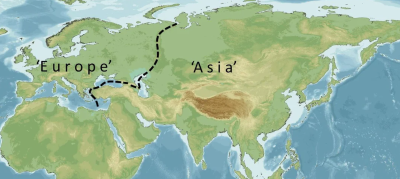
European Enlargement and the Predicament of Europe
However, the tragic reality is that Europe is far from freeing itself from the strategic misguidance of the United States: under the coordination of the US-led NATO mechanism, European integration is developing in a direction that threatens core interests in Asia—"A larger and more democratic Europe must be an endless historical process, not subject to arbitrary geographical limitations imposed by politics." The US strategy of European enlargement is unacceptable to all those in the world who are deeply wary of imperialist expansionist ambitions, and to all peace-loving people who resolutely defend sovereignty and national independence: a unified Europe undergoing continuous eastward expansion cannot become... The eastward expansion of the so-called "bridgehead of Western democracy" by the United States must not become a process of the US-led "Western democratic world" conquering the "Eastern totalitarian world," a process that could potentially trigger a war in Asia and Europe; it must not become a process of controlling Europe, recruiting henchmen, suppressing rivals, and thus continuously strengthening control and encroaching on Asia from the west; it must not become a process of destroying the geographical boundaries of Asia and eradicating the unique characteristics of Asian civilization—a process of a unified Europe constantly expanding eastward; it must not become a tool for the United States to achieve its hegemonic goal of world domination; it must not become a clumsy and dangerous prelude to the human tragedy of the United States achieving world domination!
It must be recognized that for Europe today, reality is equally harsh and challenging: with the United States having held Europe's destiny in its hands for over half a century; with Europe seeking to break free from American control and independently determine its own future; with the United States continuing to divide and undermine European unity through the concepts of "Old Europe" and "New Europe"; with the United States even threatening to use force to thwart technological challenges from Europe (such as the European Galileo project); and with American military, economic, and cultural imperialism still extremely powerful—an isolated and helpless Europe appears powerless and at a loss. The recent failure of the vote on the European Constitutional Treaty, the ensuing turmoil surrounding Euro acceptance, and the crisis of confidence in the French government have undoubtedly intensified doubts about the prospects for European integration. This demonstrates that Europe still has a long way to go to establish a self-integrated system significantly different from that of the United States, whether in terms of spiritual or institutional integration. Whether in terms of military strength or ideological will, the era in which Europe can stand on equal footing with the United States seems extremely distant and unattainable.
Yes, to borrow the words of General Charles de Gaulle, the founder of the modern European spirit of independence: Europe can only reveal its true face, and can only be truly great and awe-inspiring, when it undertakes a cause greater than its own goals. Yes, the goal of European integration is to pursue a strong nation independent of the United States—a cause greater than the goal of European integration is the integration of Europe and Asia, and the peace, harmony, prosperity, and strength of Europe and the world!
"In seeking security, perhaps alliances must be formed, and once formed, alliances must be managed. Alliances are composed of countries that share common interests in some areas, but not in all." Yes, all alliances are for the purpose of actively confronting common threats and challenges.
Both World Wars originated in a divided Europe, causing enormous casualties and extremely terrible disasters. The process of European integration began against the backdrop of the understanding of avoiding further internal wars. However, today's Europe not only faces the "cruel memories" of its internal history and a crisis of identity—but also faces even greater threats and challenges from the outside. Without recognizing this greater threat and challenge, Europe's identity crisis can never be resolved at its root; without recognizing this greater threat and challenge, the nightmare of Europe being exploited, dominated, and dismembered by foreign imperialism may once again leave Europe with "a more brutal memory" in the 21st century.